Why we built a free Lovable audit
We’re launching a free Lovable app audit, and it exists because founders kept asking us for it.
The request was almost always the same. “Look at the code behind my vibe-coded app. Tell me what the security risks are. Tell me whether it’s worth building on.”
We did that by hand for months, one call at a time. Now it’s a product: the Lovable Scale Audit. It’s free, it takes about 30 minutes, and it tells you whether your app needs a migration, a 1-1 rebuild, or just a few fixes.
What Lovable gets right
Let me say this first: I like these tools. Lovable takes you from an idea to a working prototype in a weekend, and that’s not nothing.
Most people praise vibe coding for shipping fast. I think the underrated part is failing fast. You can put something rough in front of real users and kill a bad idea before it costs you six months and a dev team.
That’s a real shift in how early-stage products get validated. The problems don’t show up at the prototype stage. They show up later, when the prototype starts acting like a business.
The “90% done” problem
On almost every call, a founder tells me some version of this: “The app is 90% done. There’s just this 10% I can’t get right.”
That 10% is the whole deal. It’s the difference between a demo and a product people pay for and trust with their data.
The frustrating part is that the last 10% is invisible from the outside. The app looks finished. The screens work. The buttons do what they should. What’s missing sits underneath, in places most non-technical founders were never shown how to look.
The four risks hiding in most vibe-coded apps
When we open up a Lovable codebase, we find the same four problems again and again.
1. Security that looks clean and isn’t
This is the one that worries me most. One founder’s security dashboard showed a single issue. When he moved the app to his own database, the same checks showed 96 critical errors.
Nothing about the app had changed. He was just finally seeing it. One common reason dashboards look clean: a policy written as USING (true) counts as RLS being “on”, even though it lets anyone read the whole table.
The patterns we find again and again in AI-generated code have names: USING (true) policies, inverted auth checks, the Supabase key shipped in the JavaScript bundle, secrets deleted from code but still alive in git history, session tokens in localStorage and wildcard CORS.
This isn’t a hypothetical risk. In 2025, CVE-2025-48757 showed that more than 170 Lovable apps were exposing data because of missing Row Level Security (RLS) policies in Supabase. Since then, security has become the first question founders ask us, and rightly so.
2. Performance that collapses under real traffic
An app that runs smoothly with 5 test users can fall over at 1,000. Inefficient queries, missing indexes and pages that load far more data than they show all feel fine in a demo. Then a launch or a good press day arrives and everything slows to a crawl.
3. Running costs that spike without warning
Nothing caps what one visitor can trigger. A single user, a bot or a bug in a loop can fire off thousands of database calls or paid AI requests. Founders often find out from the invoice.
4. Code nobody can maintain
Vibe-coded apps grow by prompt, not by plan. After a few months, every new feature breaks two old ones. Duplicated logic, unclear structure and no tests mean that each change gets slower, riskier and more expensive.
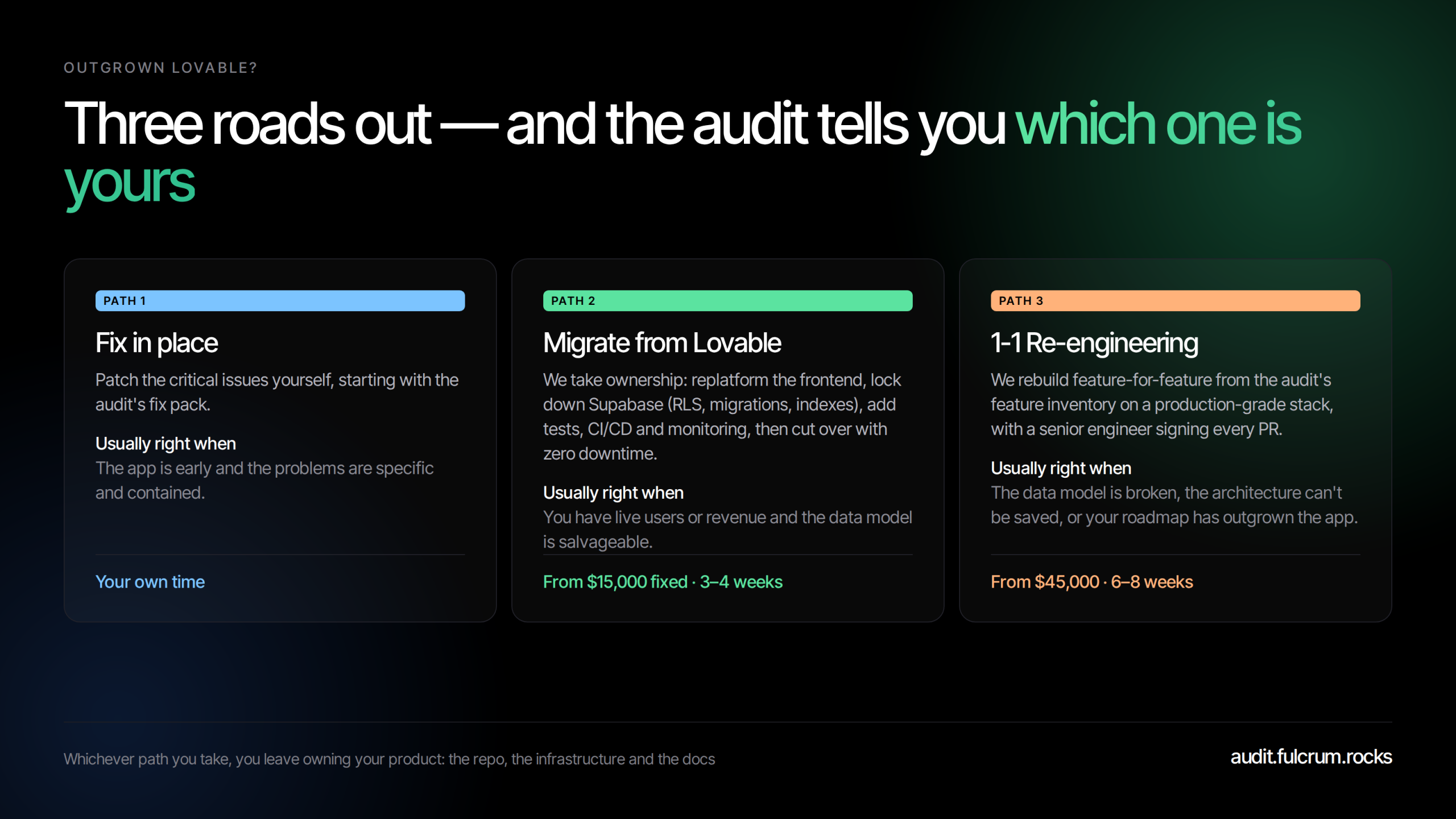
Outgrown Lovable? Fix, migrate or re-engineer
Sooner or later, every founder with a Lovable app lands at the same fork. There are three roads, and the right one depends on what’s actually in your code.
And you don’t have to take that path with us. The report is yours, so you can hand it to any team. If you’re comparing partners, I put together a field guide to the best software development companies in Ukraine, grouped by stage and domain, with real price ranges and the red flags to watch for.
For months, we answered “which path?” from scratch on every single call. When you do the same thing that many times, it should probably be a product. So we built one.
What the Lovable Scale Audit checks
The Lovable Scale Audit is free. Connect GitHub with read-only access to a single repo, and in about 30 minutes it checks the five things that decide whether your app survives real users:
- Security: your Supabase RLS policies translated into plain English, secrets left in your git history, and known vulnerabilities (CVEs) in your dependencies.
- Scalability: how the app behaves when traffic grows from tens of users to thousands.
- Running costs: where usage can spike, including AI cost-abuse exposure, meaning what one visitor or bot can run up on your LLM bill.
- Code quality: structure, duplication and how safe it is to add new features.
- Understanding: whether you actually know what you’ve built, feature by feature.
How it differs from Lovable’s built-in security scan
Lovable now ships its own security scan, and you should use it. It lints RLS, detects secrets and checks dependencies inside the platform. Our audit picks up where a platform linter stops.
| Question | Lovable's scan | Lovable Scale Audit by Fulcrum |
|---|---|---|
| Is RLS turned on? | Yes | Yes |
| Do your policies actually do what you think? | Limited | Every policy translated into plain English: who can read and write what, per table |
| Are deleted keys still in your git history? | No | Full-history secrets scan |
| What can one visitor cost you? | No | AI endpoints without auth or rate limits, with an estimated $/hour exposure |
| What breaks at 1,000 users? | No | Missing indexes, N+1 queries, unbounded queries, tied to your growth |
| What does it cost to fix or move? | No | Price ranges for migration and 1-1 re-engineering |
Every finding in the report is tagged confirmed, likely or hygiene. Confirmed means we proved it in your code and can show you where.
That last one surprises people. Many founders can’t list every feature their app has, because they described them in prompts rather than designed them. You can’t secure, scale or sell what you can’t see.
What you get: a plain-English report
The output is a report written for founders, not just engineers. It works whether or not you can read code.
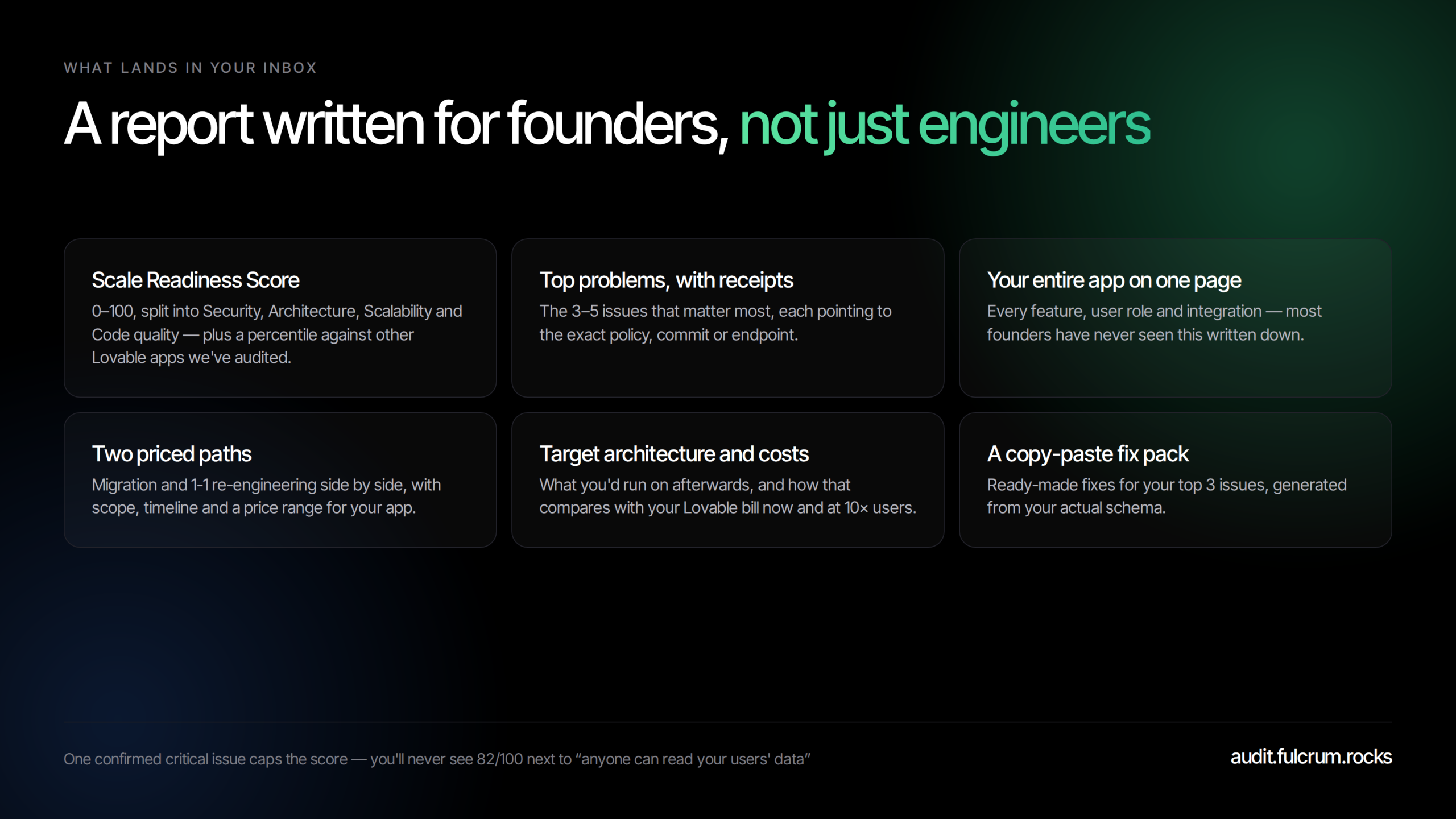
- A Scale Readiness Score: one number from 0 to 100, split into four sub-scores (Security, Architecture, Scalability, Code quality), plus a percentile against other Lovable apps we’ve audited. Every point traces back to a finding, and one confirmed critical issue caps the score, so you’ll never see 82/100 next to “anyone can read your users’ data”.
- Top problems, with receipts: the 3–5 issues that matter most, each pointing to the exact policy, commit or endpoint.
- What breaks at 1,000 users: a short, plain explanation of where your app fails as it grows.
- Your entire app on one page: a feature inventory of every feature, user role and integration.
- Two priced paths: migration and 1-1 re-engineering side by side, with scope, timeline and a price range for your specific app.
- Target architecture and running costs: what your app would run on after a migration or rebuild, and how your Lovable subscription and credits compare with owning your infrastructure, now and at 10× users. If Lovable is cheaper at your size, the report says so.
- A verdict: our recommendation and why. The report ends with a decision, not homework.
- A copy-paste fix pack: ready-made fixes for your top 3 issues, generated from your actual schema.
If your app turns out to be in good shape, the report says that too, with the receipts to prove it.
The report is yours to keep and share. Send it to a co-founder, a technical advisor or an investor running technical due diligence.
What happens to your code
Asking for your repo is a big ask, so here’s exactly what we do with it:
- Read-only access to a single repo. We use a GitHub App that can’t write to your code or see your other repos.
- Encrypted while we hold it. Only the audit pipeline can access it.
- Deleted after 14 days. Your code is auto-deleted 14 days after the report is delivered, and you get an email confirming it.
- Never reused. We don’t train on your code or use it for anything except your audit.
- No credit card. The audit and the estimate are free. You only pay if you hire us.
How to run the audit
- Enter your email. That’s the only form field.
- Connect GitHub. Pick the one repo you want audited. Not synced yet? In Lovable, go to Settings → GitHub → Connect. It takes two clicks.
- Get your report. It arrives by email in about 30 minutes, so there’s no need to wait on the page.
- Optional: book a walkthrough. Go through the findings with an engineer and leave with a fixed price.
On your phone? Start there, and we’ll email you a link to connect your repo from your computer.
From audit to a fixed price
The audit gives you ranges. If you want to go further, we book a 30-minute walkthrough call, go through the findings together, and lock in a fixed price. Estimate ranges stay valid for 30 days.
Some apps are genuine outliers, with 100+ database tables or a sprawl of edge functions. For those, the audit still gives you every finding but no automatic price. We scope them with you directly, because a template price would be a guess.
Quick self-check: does your Lovable app need an audit?
If you tick two or more of these, it’s worth running the audit before your next launch or fundraise.
- You’re about to onboard paying customers or real user data
- You can’t say for sure who can read or edit each table in your database
- You’ve never tested the app with more than a handful of users at once
- Your hosting, database or AI bills have jumped without an obvious reason
- Fixing one bug regularly creates another
- A developer, agency or investor has asked about your code and you weren’t sure what to say
- You’re planning to hire developers to keep building on the current codebase
FAQ
-
Is the Lovable audit really free?Yes. No credit card, no trial that converts into a subscription. You get the report, the score and the fix pack for free.
-
Do I need to be technical to use it?No. The report is in plain English and works whether or not you can read code. If you do have a developer, they'll get the detail they need too.
-
Will the audit change my code?No. You connect GitHub with read-only access to a single repo. We never write to it.
-
Do you keep my code?No. It's encrypted while we hold it and auto-deleted 14 days after your report is delivered. You get an email confirming the deletion, and we never train on or reuse it.
-
Lovable already has a security scan. Why do I need this?Lovable's scan is a good first check, and you should run it. Our audit goes further: it reads what your RLS policies actually allow, scans your full git history for leaked keys, estimates what an abused AI endpoint could cost you, and prices the way forward.
-
What if my app is in good shape?Then the report tells you so, with the receipts, plus a fix pack for whatever small issues it finds.
-
Is my Lovable app secure?Maybe, but a clean-looking dashboard isn't proof. In one case, one reported issue turned into 96 critical errors once the app moved to its own database. CVE-2025-48757 exposed 170+ Lovable apps through missing RLS policies. The audit translates your RLS policies into plain English and checks for exposed secrets and vulnerable dependencies.
-
Can a Lovable app handle thousands of users?It can, if the queries, data access and infrastructure are built for it. Many vibe-coded apps aren't, because they were only ever tested with a few users. The scalability check shows where yours would break.
-
Should I migrate or rebuild my Lovable app?It depends on your data model and architecture. If the data model is salvageable and you have live users, migration is usually faster and cheaper (from $15,000, 3–4 weeks). If it isn't, a 1-1 re-engineering rebuilds the same features properly (from $45,000, 6–8 weeks). The audit tells you which one you need.
-
How much does it cost to migrate from Lovable?Standard migrations start at $15,000 fixed. More complex apps typically land between $30,000 and $60,000. Your audit report includes a price range for your specific app.
-
How long does the audit take?About 30 minutes from connecting your repo to getting the report.
-
I built with Bolt, Replit or v0. Can I still use it?Yes. The audit was built around Lovable, but it works on apps from other AI app builders too.
-
What happens after the audit?The report, score and fix pack are yours. Fix things yourself, hand them to your team, or book a walkthrough call if you want us to migrate or rebuild it. After that, our dedicated team can keep building with you.
Run your free Lovable Scale Audit
If you’ve built something with Lovable and don’t know what’s underneath it, run the audit. It takes about 30 minutes, and you’ll know where you stand before your users find out for you. You can run Lovable audit here.
And if you’ve built something with Lovable, I’d love to hear how it went. What worked, and where did you get stuck? Reply in the comments or reach out to me directly