
I run Fulcrum, an AI-powered product engineering company in Kyiv, and healthcare is a big part of what we build. Last month I spent a day at Digital Medicine Forum 2026 listening to clinic owners, IT directors and doctors talk about what’s actually going wrong with their software. Spoiler: it’s rarely the code. It’s scattered data, systems that don’t talk to each other, nobody owning the project, and a very real fear of who’s liable when something breaks.
So this guide does two things. It lists the Ukrainian healthcare software development companies I’d actually look at, with what each one is best for. And it tells you what to check before you sign, based on what I heard from the people who live with these products every day.
TL;DR
- Ukraine has some of the strongest healthcare software teams in Europe, with rates of roughly $25–70/hour, well below comparable US teams.
- Pick by what you’re building, not by size. A telehealth MVP, a FHIR interoperability platform and medical-device software need very different partners.
- The hard part of healthcare software is rarely the code. It’s integration with the clinic’s existing systems, data access, security and clear ownership.
- Ask every vendor how their product fits into the doctor’s existing workflow. Tools that add another screen don’t get used.
- For AI projects, start small: one process, a baseline, a KPI and a 90-day pilot, with a human making the clinical decision.
- Check named certifications (HIPAA, GDPR, HL7/FHIR, ISO 27001, ISO 13485) and shipped healthcare products, not promises.
Why healthcare software is harder than it looks
Before the list, a quick detour, because it changes how you should judge every company on it.
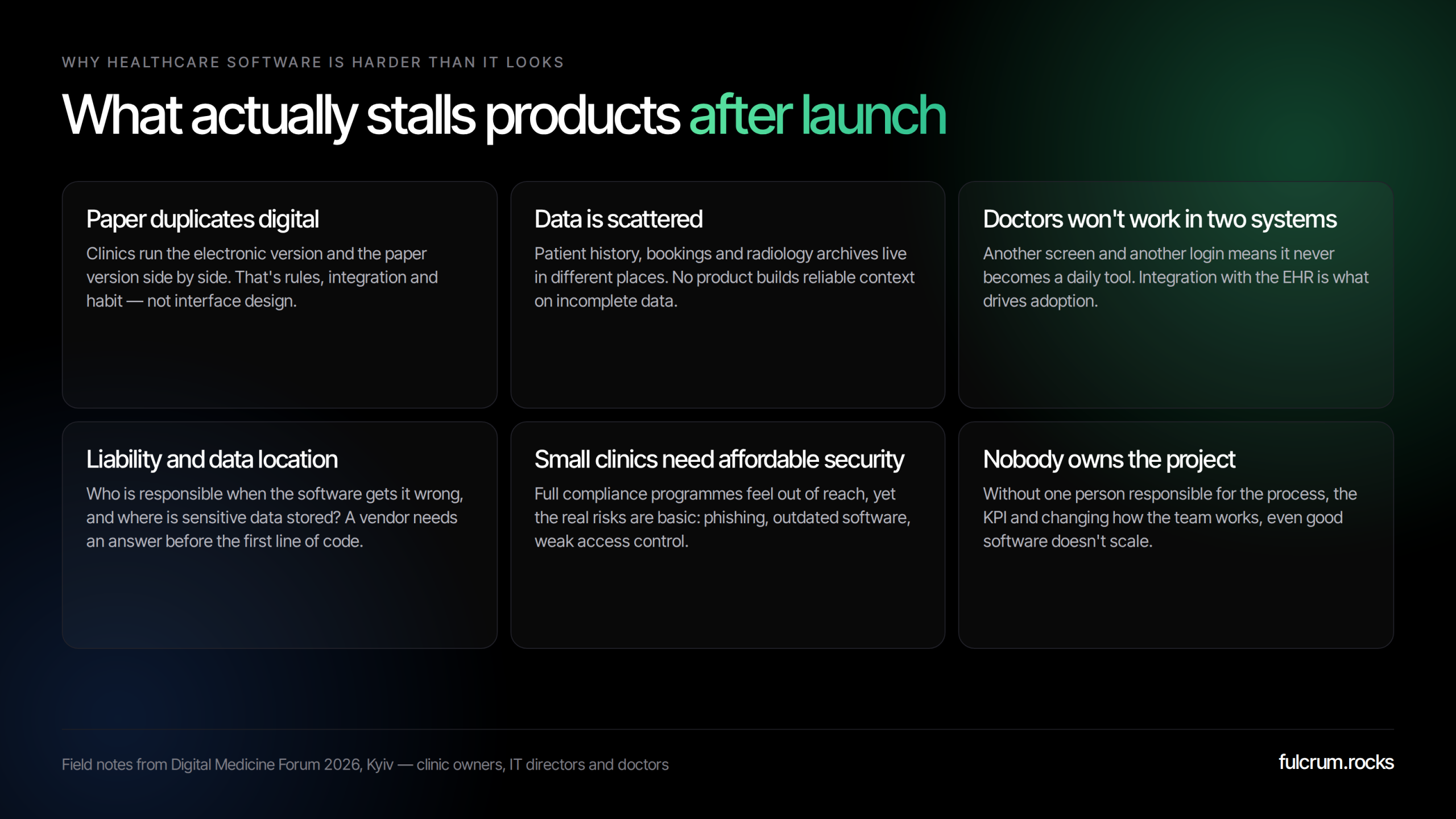
At Digital Medicine Forum in Kyiv, I expected a day of AI hype. What I got was a very honest picture of why so many healthcare products stall after launch. Here’s what kept coming up:
- Paper still duplicates digital processes. Clinics often run the electronic version and the paper version side by side. That’s a question of rules, integration and habit, not interface design.
- Data is scattered and hard to reach. Patient history, bookings and radiology archives live in different places. No product, AI or otherwise, can build reliable context on incomplete data.
- Doctors won’t work in parallel systems. If your product adds another screen and another login, it won’t become a daily tool. Integration with the clinic’s medical information system (its EHR) is what drives adoption.
- Liability and data location are the condition for trust. Who’s responsible if the software gets it wrong? Where is sensitive data stored? A vendor needs a clear answer before the first line of code.
- Small clinics need security they can afford. Full compliance programmes feel out of reach, yet their real risks are basic: phishing, outdated software and weak access controls.
- Nobody owns the project. Without one person responsible for the process, the KPI and changing how the team works, even good software doesn’t scale.
How I picked these medical software development companies
Every company on this list is Ukrainian or has its main engineering base in Ukraine. I looked at five things:
- Healthcare focus. Shipped products in healthcare, not just a “healthcare” page on the website.
- Compliance depth. Named standards and certifications: HIPAA, GDPR, HL7, FHIR, DICOM, ISO 27001, ISO 13485.
- Integration experience. EHR and medical information system integrations, interoperability, legacy systems.
- Delivery model. How they price, how fast they ship, and whether their incentives point at your result.
- Fit by use case. Who each company is genuinely best for.
The order reflects how well each company covers the challenges above for a typical healthtech startup or clinic, not just its size. If you’re building medical-device software or a national-scale interoperability platform, jump to the companies I flag for that.
11 best healthcare software development companies in Ukraine
1. Fulcrum
Kyiv · AI-powered product engineering · HIPAA, GDPR, HL7
Fulcrum builds telehealth, diagnostics and wellness products with compliance designed into the architecture from day one, not bolted on at the end. We’ve shipped 50+ products, a few of which scaled past 12M users, and we hold a 4.9 rating on Clutch.
What I think sets us apart in healthcare is that we start with the process, not the technology. Everything I described above, from scattered data to doctors who won’t use another screen, is what we plan for in the first week:
- One process, one owner, one KPI. We pick the process with the biggest manual losses and agree a baseline before we build.
- Integration into the existing workflow. Results go back into the system the team already uses, so adoption doesn’t depend on people learning a new tool.
- Doctors stay in control. AI drafts, checks and highlights. The clinical decision stays with the specialist.
- Security by design. Data minimisation, role-based access, logging and de-identification where possible.
Healthcare work you can look at:
- QuickTouch: a tool that gives healthcare professionals the information and specifications of any medical device in seconds. We built it from the ground up in 8 weeks.
- Vie: an AI-powered fertility platform, where we built a RAG model on scientific research.
- FlipMD: a medical marketplace we shipped in a few months. It was later acquired by GoodRx.
After launch, our 24/7 AI-augmented team (product owner, designer, QA and engineers, plus AI agents) keeps the product moving on a monthly retainer, and our AI-first legacy modernization typically lands 40–50% faster than a rebuild. We’ve also published a practical HIPAA compliance guide.
Best for: healthtech startups and clinics that want one partner to own delivery end to end, from process discovery and compliant architecture to AI features and integration, and ship production-grade software fast.
When to pick someone else: if your product is regulated medical-device software that needs ISO 13485 processes, or a national-scale FHIR interoperability platform, look at Jelvix or Edenlab below.
2. Empeek
Lviv · healthcare-only · HIPAA, GDPR, HL7, FHIR, DICOM
Empeek was founded in 2015, has roughly 150–250 people, and does healthcare and basically only healthcare. Their work covers remote patient monitoring, EHR integrations, telehealth and AI diagnostics, and they’ve cited 90%+ accuracy on automated heart-monitoring classification. That kind of focus means you won’t be paying for their healthcare education.
Best for: US providers and healthtech companies that want a pure-play healthcare specialist.
3. Edenlab
Ukraine · healthcare interoperability · FHIR-native
Edenlab is one of the more serious interoperability shops anywhere. They’re behind a national e-prescribing system that issues around a million prescriptions a month, and they built Kodjin, an ONC-certified healthcare data platform. If your product lives or dies on moving clinical data between systems, they speak that language natively.
Best for: interoperability-heavy products, FHIR platforms and large-scale health data exchange.
4. Jelvix
Estonia and Ukraine · healthcare vertical · HIPAA, GDPR, ISO 27001, ISO 13485
Jelvix was founded in 2011 and has around 450 people across Estonia, Ukraine, Germany and the UK. Healthcare is a core vertical, with compliance designed in across HIPAA, GDPR and ISO 27001. Notably, they also hold ISO 13485, the quality standard for medical devices.
Best for: medical-device software and products that need device-grade process and certifications.
5. Binariks
Lviv · healthcare modernization · ISO 27001, ISO 9001
Binariks was founded in 2014 and has 200+ people. Their superpower is legacy modernization: moving healthcare organisations off on-premise systems into HIPAA- and GDPR-compliant cloud on AWS, Azure or GCP, without disrupting clinical operations mid-move.
Best for: healthcare organisations with ageing systems that need a careful migration to the cloud.
6. Demigos
Ukraine · HealthTech and AgeTech · HIPAA, GDPR
Demigos is a HealthTech and AgeTech specialist that leans product-minded. They take startups from business analysis and prototyping through to HIPAA- and GDPR-compliant telemedicine and EMR builds.
Best for: early-stage healthcare startups that want product thinking alongside compliant engineering.
7. Abto Software
Lviv · AI/ML and R&D · HIPAA, GDPR, HL7, FHIR, DICOM
Abto Software brings nearly two decades of engineering and 70+ delivered healthcare projects, for clients from small practices to hospitals. Their portfolio covers EHR/EMR modernization, virtual clinics, prescriptions, pharmacy management and digital physical therapy, with strong AI/ML and computer-vision skills behind it.
Best for: providers modernizing existing systems or adding advanced AI to them.
8. Leobit
Lviv · full-cycle development · ISO 9001, ISO 27001, HIPAA, GDPR
Leobit has 10+ years of experience and 150+ delivered solutions, with a strong HealthTech focus. They build EHR/EMR systems, telemedicine platforms, patient engagement tools and clinical decision support, and they’re particularly strong on the Microsoft and .NET stack.
Best for: healthcare companies building on Microsoft technologies who want a full-cycle partner.
9. TechMagic
Lviv · JavaScript specialists · CREST-certified security
TechMagic was founded in 2014, has 350+ people and offices in Kyiv and Kraków. They run dedicated JavaScript, Node and React teams, with healthtech as one of their key verticals alongside fintech, and a CREST-certified security practice. Their healthcare work includes AI-based diagnostic tools, patient monitoring and analytics.
Best for: scaling healthtech products that need a senior JavaScript squad with strong security practices.
10. ELEKS
Lviv · enterprise engineering · AI-powered healthcare solutions
ELEKS focuses on AI-powered healthcare solutions that help providers use their data for clinical decision-making. They’re known for integrating new platforms with legacy systems, so organisations can modernize without stopping operations.
Best for: larger healthcare providers modernizing legacy systems while keeping operations running.
11. Cleveroad
Kharkiv · full-cycle web and mobile · ISO 9001, ISO 27001
Cleveroad was founded in 2011, is headquartered in Kharkiv and has offices in the US and UK. They deliver full-cycle web and mobile products across healthtech, logistics, fintech and e-commerce, and reviewers consistently mention budget-friendly pricing.
Best for: healthcare startups that want end-to-end app development at a competitive rate.
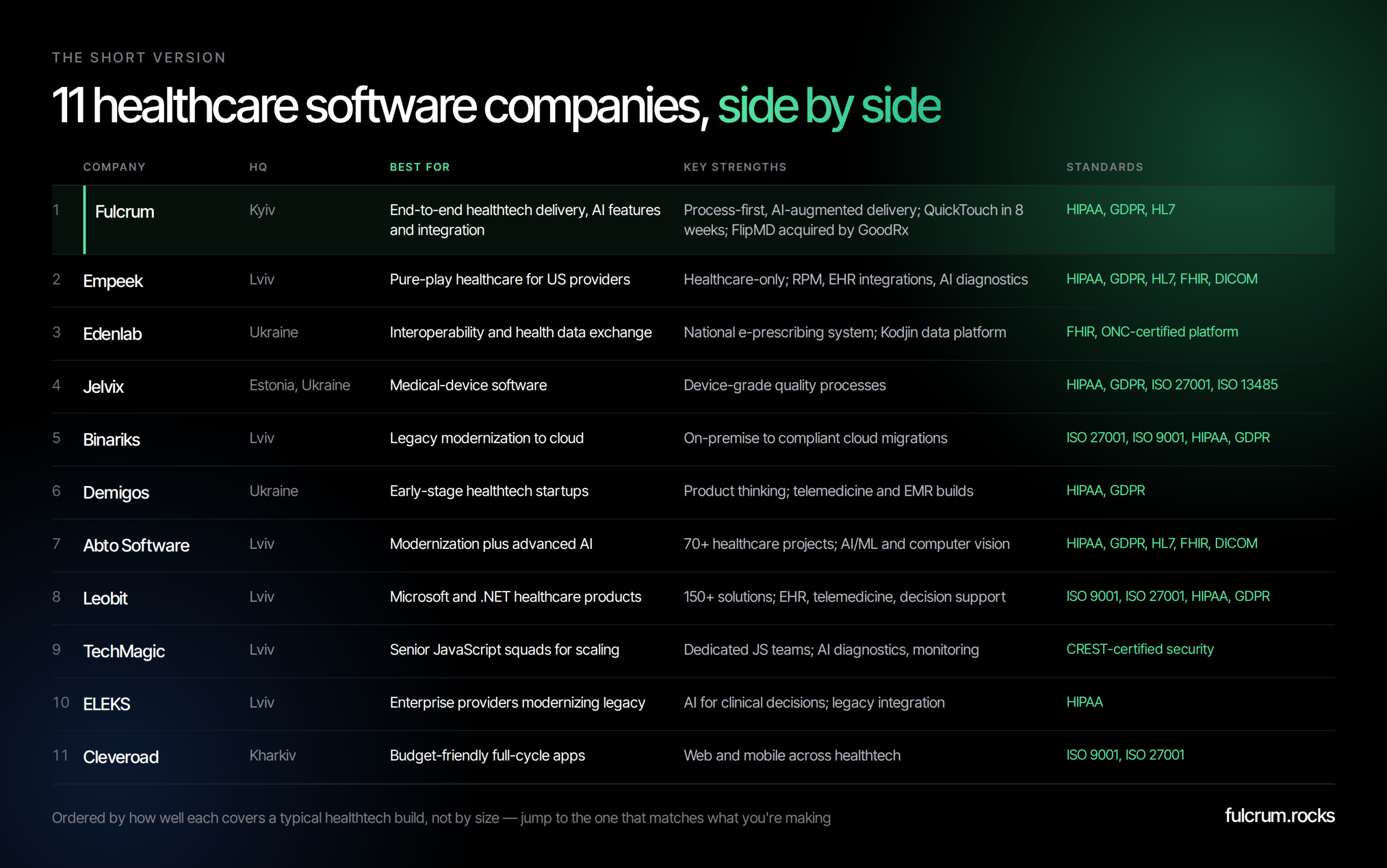
Healthcare software development companies in Ukraine: comparison table
The short version of everything above, so you can shortlist in a minute.
How to choose a healthcare software development company
Here’s the checklist I’d use if I were on your side of the table. Each point comes straight from the problems clinics described at the forum.
1. Check that they’ve shipped in healthcare, not just written about it
Ask for two products in your segment (telehealth, diagnostics, EHR, medical devices) and talk to those clients. Then ask about the standards they’ve actually worked with: FHIR, HL7, DICOM and the clinical coding systems your product will touch. That knowledge takes years to build and is hard to fake on a call.
2. Ask how the product fits into the existing workflow
This is the question most vendors skip. Which system is the source of truth? Can the product read from and write back to the clinic’s EHR or medical information system? Who approves the integration on the client side? If the answer is “doctors will just use our app”, be careful.
3. Make them explain security and liability in plain words
Where will patient data be stored? Who can access it, and is every access logged? Is data de-identified where it can be? For AI features, who makes the final clinical decision? A good partner treats compliance as an architecture decision on day one, not an end-of-project checklist.
4. Ask what the first 90 days look like
Big transformation projects rarely start. Narrow pilots do. A strong partner will propose one process, a baseline, a KPI and a clear decision point: scale, change or stop. If budget follows proof, this is how you get the proof.
5. Find out who owns the project on both sides
Ask who your day-to-day contact is, and be honest about who owns the process inside your organisation. Without an owner for the process, the KPI and the rules of use, even good software doesn’t get adopted.
6. Look at incentives, not just hourly rates
A team that bills pure hours earns more when your project runs longer. Ask how they price, what’s fixed, and what happens to your timeline and bill when they work faster.
How much healthcare software development costs in Ukraine
Expect roughly $25–70 per hour for healthcare work in Ukraine, about 40–70% below comparable US rates. Genuine compliance depth comes at a premium, and it’s worth paying: a team learning HIPAA on your project costs more in rework than it saves on rates.
The engagement model matters as much as the rate:
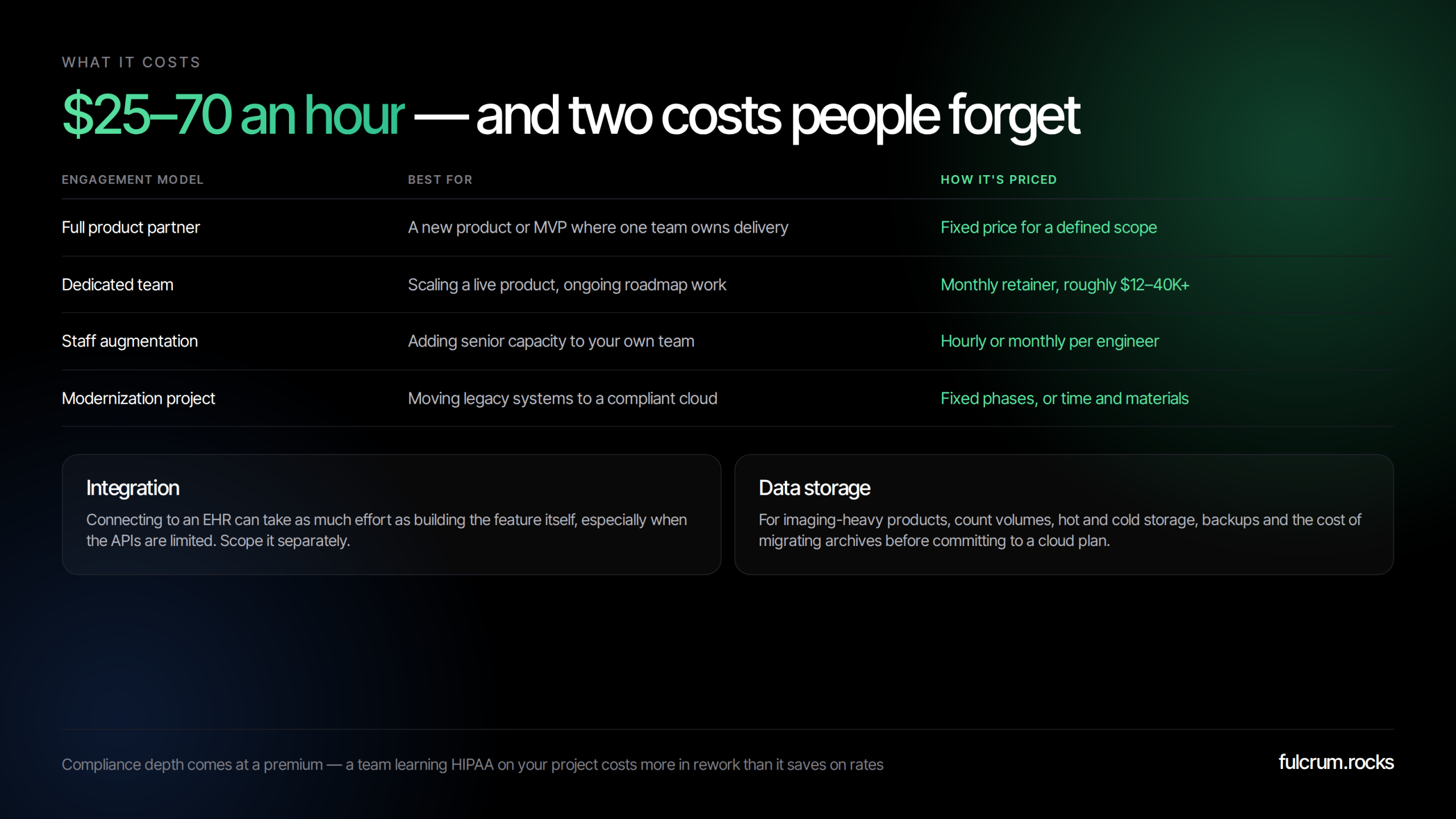
Two costs people forget:
- Integration. Connecting to an EHR or medical information system can take as much effort as building the feature itself, especially when APIs are limited. Ask for it to be scoped separately.
- Data storage. For imaging-heavy products, cloud storage is a real line item. Count data volumes, hot and cold storage, backups and the cost of migrating archives before you commit to a cloud plan.
For comparison, Fulcrum’s 24/7 AI-augmented product team runs from $12–20K per month as a retainer with clear deliverables, not hourly billing.
The whole thing in one breath
In healthcare, the code is the easy part. The hard part is everything around it: messy data, systems that don’t talk to each other, doctors with no time for another tool, and real questions about liability and security. The best healthcare software development company for you is the one that plans for all of that from day one, not just the one with the longest feature list.
Pick by what you’re building, check shipped work and named certifications, ask how the product fits into the existing workflow, and start with a narrow pilot that proves value fast.
If you’re building a healthtech product or planning your first AI pilot and want a straight answer on where to start, even if that answer is “talk to someone else on this list”, my inbox is open. See how Fulcrum builds healthtech products.
If you’re still comparing partners outside healthcare, my broader guide to the best software development companies in Ukraine groups them by stage and domain.
-
What is the best healthcare software development company in Ukraine?There isn't one best company for everyone. For end-to-end delivery of a healthtech product with AI and integration, I'd start with Fulcrum. For medical-device software, look at Jelvix. For large-scale interoperability, Edenlab. For a healthcare-only specialist serving US providers, Empeek. Match the company to what you're building.
-
Are Ukrainian developers HIPAA-compliant?Many are, but HIPAA compliance is about how a specific product is built and run, not a badge a company holds. Ask for shipped HIPAA-compliant products, how they handle access control, logging and encryption, and whether they'll sign a Business Associate Agreement.
-
How much does healthcare software development cost?In Ukraine, expect roughly $25–70 per hour, or a monthly retainer for a dedicated team. The total depends on scope, compliance requirements and especially integrations, which are often underestimated.
-
How long does it take to build healthcare software?It depends on scope. A focused product can ship in weeks: we built QuickTouch from the ground up in 8 weeks. Complex platforms with several EHR integrations take much longer, and integration approvals on the client side are often the slowest part.
-
Can AI be used safely in healthcare software?Yes, when it supports specialists rather than replacing them. Use de-identified or read-only data where possible, log every access, keep the scope narrow and leave the clinical decision with the doctor.
-
Are Ukrainian teams reliable given the war?Yes. Teams here have kept shipping through very hard conditions, and many engineers now work distributed across the EU. A responsible partner will tell you exactly where people are based and how continuity is protected. Ask directly.
-
Do Ukrainian companies work in US time zones?Ukraine gives you about 4–6 hours of overlap with US business hours and full overlap with Europe.