

AI in clinics is no longer a question of “if”. In 2026, it’s a question of where to start and how not to waste the first year. That was my biggest takeaway from Digital Medicine Forum 2026 in Kyiv on September 15.
I went expecting a day of AI hype. Instead, I heard clinic owners, IT directors and doctors talk about paper, scattered data, legal risk and staff who don’t have time to learn another system. AI came up constantly, but it was never the starting point. Data, processes and security were.
Here’s what I learned about what actually works, what blocks AI adoption in healthcare, and how I’d start if I ran a clinic today.
The short version
- Clinics don’t want “AI”. They want one painful process fixed, safely and with a result they can measure.
- AI works best when it supports doctors, not replaces them: quality control of medical reports, a doctor’s assistant, anonymised analytics, call centres and scheduling.
- Scaling is blocked by the basics, not the models: scattered data, weak integration with the clinic’s systems, no clear owner, tight budgets and security fears.
- If AI lives outside the medical information system, doctors won’t use it. Integration is part of the product.
- Security isn’t an obstacle to the sale. It’s part of what clinics are buying.
- The realistic way in is a 90-day pilot of one process, with a baseline, a KPI and a decision agreed in advance.
Where AI is actually working in clinics
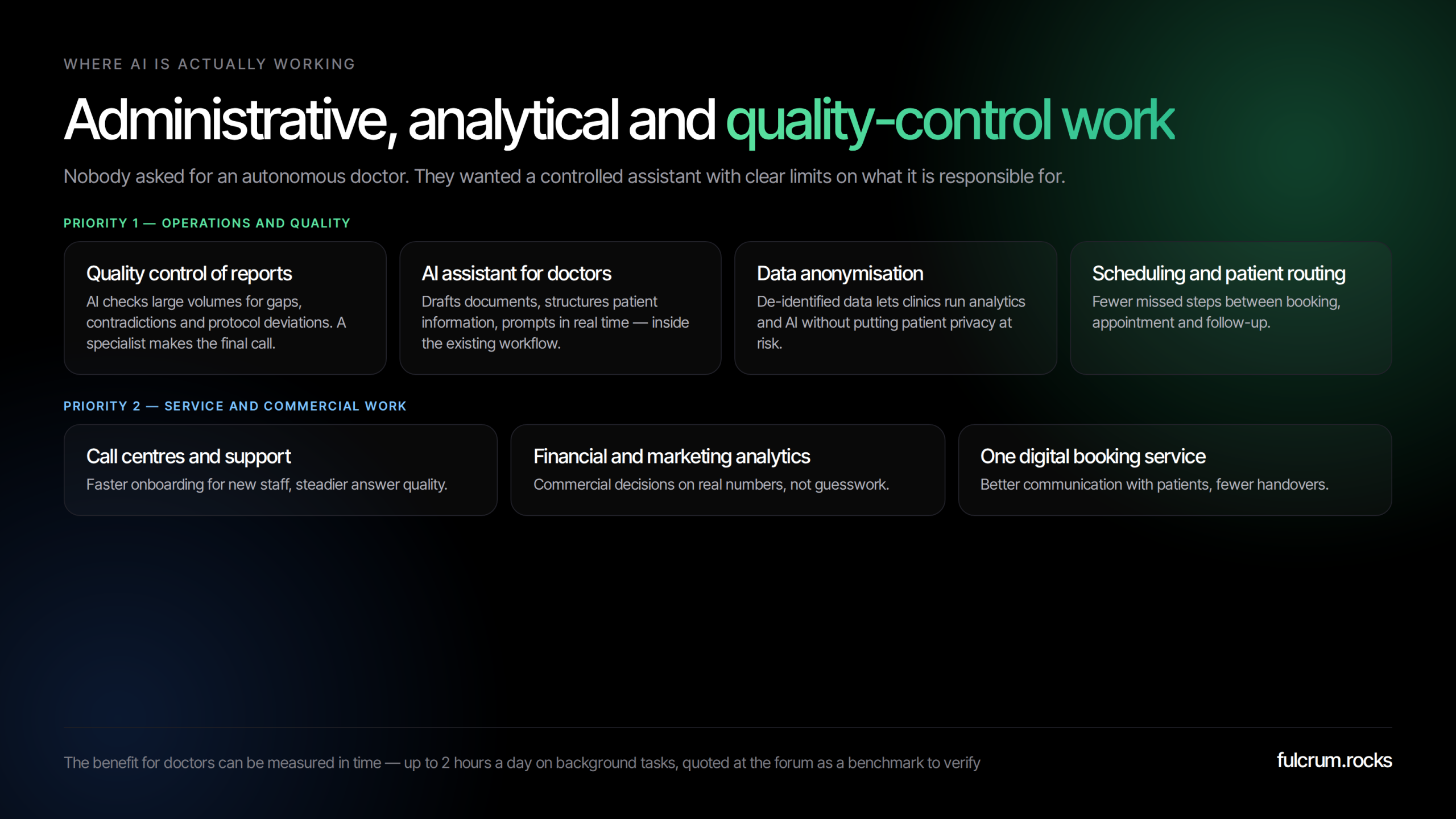
The most mature healthcare AI use cases today are administrative, analytical and quality-control work. Nobody at the forum was asking for an “autonomous doctor”. They wanted a controlled assistant with clear limits on what it’s responsible for.
Priority 1: operations and quality
- Quality control of medical reports and prescriptions. AI checks large volumes of reports for gaps, contradictions and deviations from the template or protocol. A specialist still makes the final call.
- An AI assistant for doctors. It drafts documents, structures patient information and gives prompts in real time, so doctors spend less time on paperwork.
- Data anonymisation. De-identified data lets clinics run analytics and use AI without putting patient privacy at risk.
- Scheduling, resources and patient routing. Fewer missed steps between booking, appointment and follow-up.
Priority 2: service and commercial work
- Call centres and support, including training new staff faster.
- Financial, marketing and advertising analytics.
- One digital booking service and better communication with patients.
The benefit for doctors can be measured in time. One figure mentioned at the forum was up to 2 hours a day saved on background tasks. Treat that as a benchmark to test in your own clinic, not a promise.
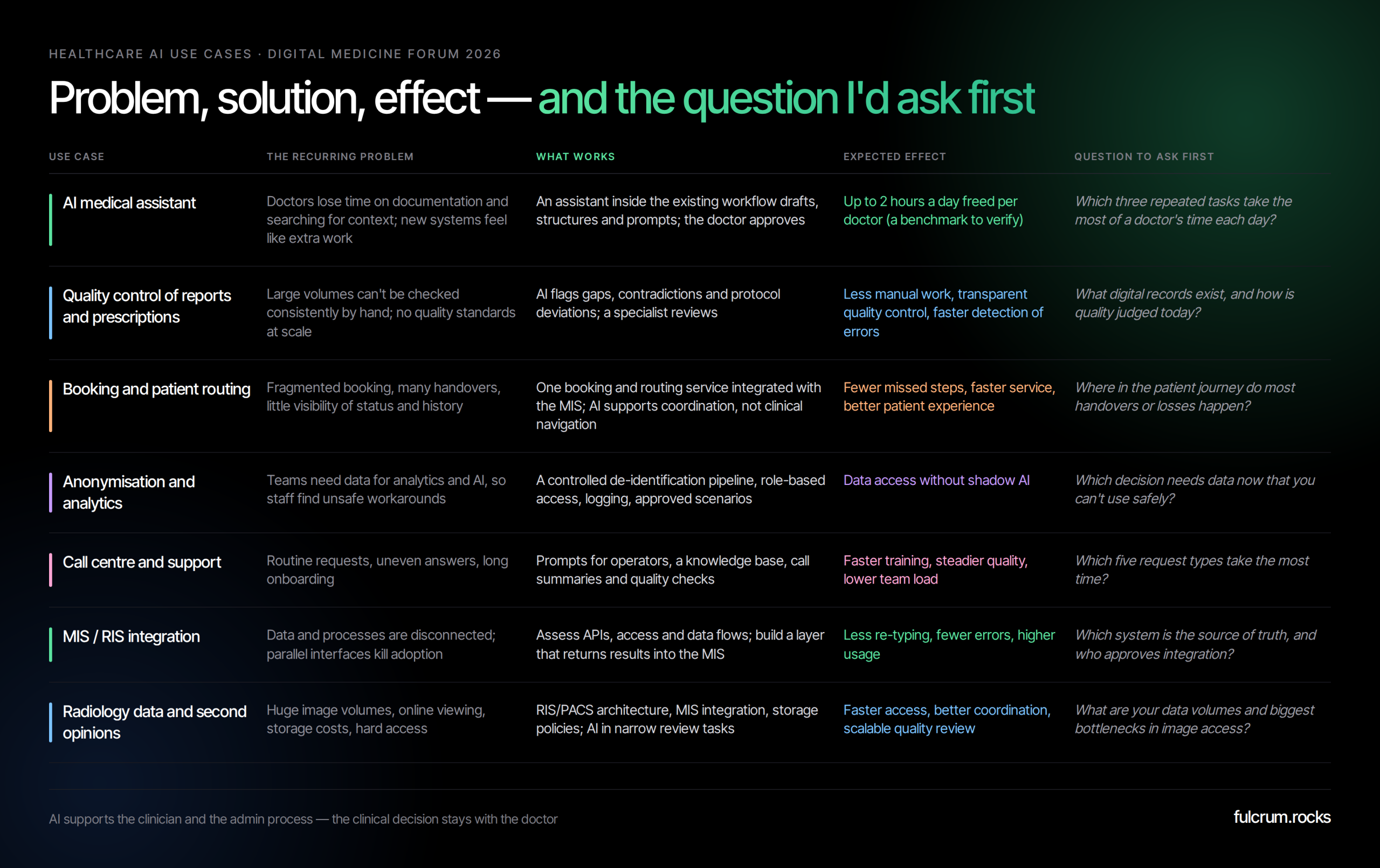
Healthcare AI use cases: problem, solution, effect
These came up again and again at the forum. None of them replaces a clinician. Each one takes a specific piece of work off someone’s plate, and each one has a question worth asking before you build anything.
An AI assistant for doctors
Doctors lose hours to documentation and to hunting for context that already exists somewhere in the system. Most tools fail here because they arrive as yet another thing to learn. What works is an assistant that lives inside the workflow doctors already use: it drafts, structures the information and prompts, and the doctor approves the result. The figure quoted at the forum was up to two hours a day freed per specialist — treat that as a benchmark to test in your own clinic, not a promise. Before you start, find out which three repeated tasks actually eat the most of a doctor’s day.
Quality control of reports and prescriptions
Nobody can read every report by hand, so in practice the standard depends on who is on shift that day. AI can check the whole volume for gaps, contradictions and deviations from the protocol, then flag the few that need a human look. A specialist still reviews and decides. The gain is less manual checking, quality control you can actually see, and errors caught earlier. The first thing to establish: what digital records already exist, and how quality is judged today.
Booking and patient routing
Bookings sit in different places, cases get handed over by phone and on paper, and nobody can see the full status or history. The fix is one booking and routing service connected to the medical information system, with AI supporting coordination rather than clinical navigation. Fewer steps get dropped, service gets faster, and patients notice. Ask where in the patient journey most handovers or losses happen.
Anonymisation and analytics
Teams need data to run analytics and AI, and when there is no safe way to get it, they invent an unsafe one — a spreadsheet here, a private tool there. A controlled de-identification pipeline with role-based access, logging and a list of approved scenarios gives them the data without the shadow IT. The question to start with: which decision needs data right now that you cannot safely use?
Call centre and support
The same routine requests, answered at uneven quality, with new agents taking months to get up to speed. Prompts for operators, a maintained knowledge base, automatic call summaries and quality checks shorten training and steady the answers. Start by finding which five request types consume the most time.
Integration with the medical information system
This is the one that decides whether anything else gets used. When data and processes are disconnected, staff end up working in parallel interfaces, and adoption quietly dies. The work is unglamorous: assess the APIs, the access rights and the data flows, then build a layer that returns results into the system doctors already have open. Less re-typing, fewer errors, more actual usage. Ask which system is the source of truth, and who signs off on integration.
Radiology data and second opinions
Image archives are huge, online viewing is expected, storage costs real money and access is often slow. The answer is architectural before it is clever: a proper RIS/PACS setup, integration with the medical information system, and an explicit storage policy, with AI used for narrow review tasks. That buys faster access, better coordination and quality review that scales. Start with your data volumes and the biggest bottlenecks in getting to an image.
What’s stopping AI adoption in healthcare
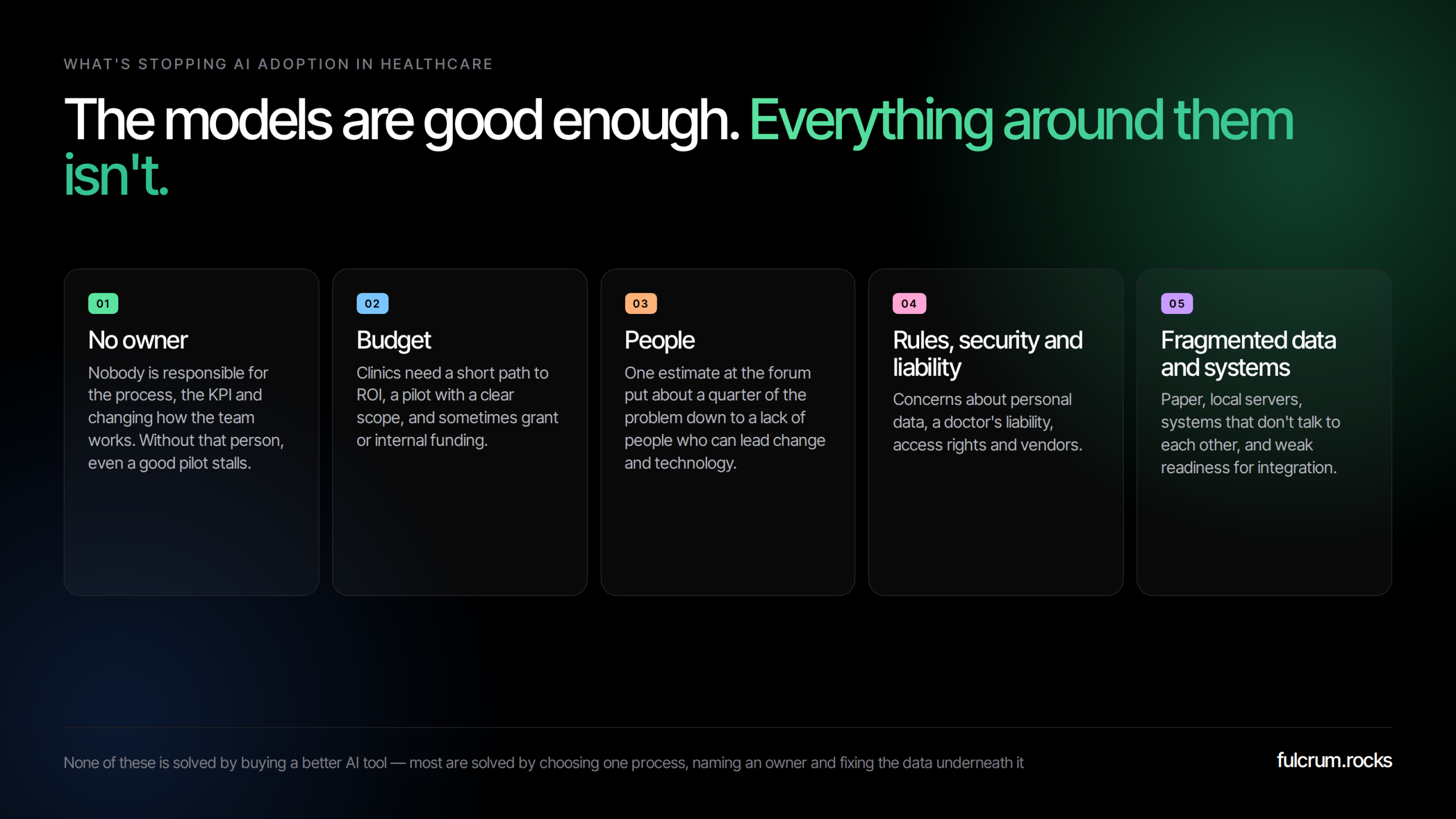
The models are good enough. What slows AI down in clinics is everything around them. Five barriers came up again and again:
- No owner. Nobody is responsible for the process, the KPI and changing how the team works. Without that person, even a good pilot stalls.
- Budget. Clinics need a short path to ROI, a pilot with a clear scope, and sometimes grant or internal funding options.
- People. One estimate at the forum put about a quarter of the problem down to a lack of people who can lead change and technology.
- Rules, security and liability. Concerns about personal data, a doctor’s liability, access rights and vendors.
- Fragmented data and systems. Paper, local servers, different systems that don’t talk to each other, and weak readiness for integration.
None of these is solved by buying a better AI tool. Most of them are solved by choosing one process, naming an owner and fixing the data underneath it.
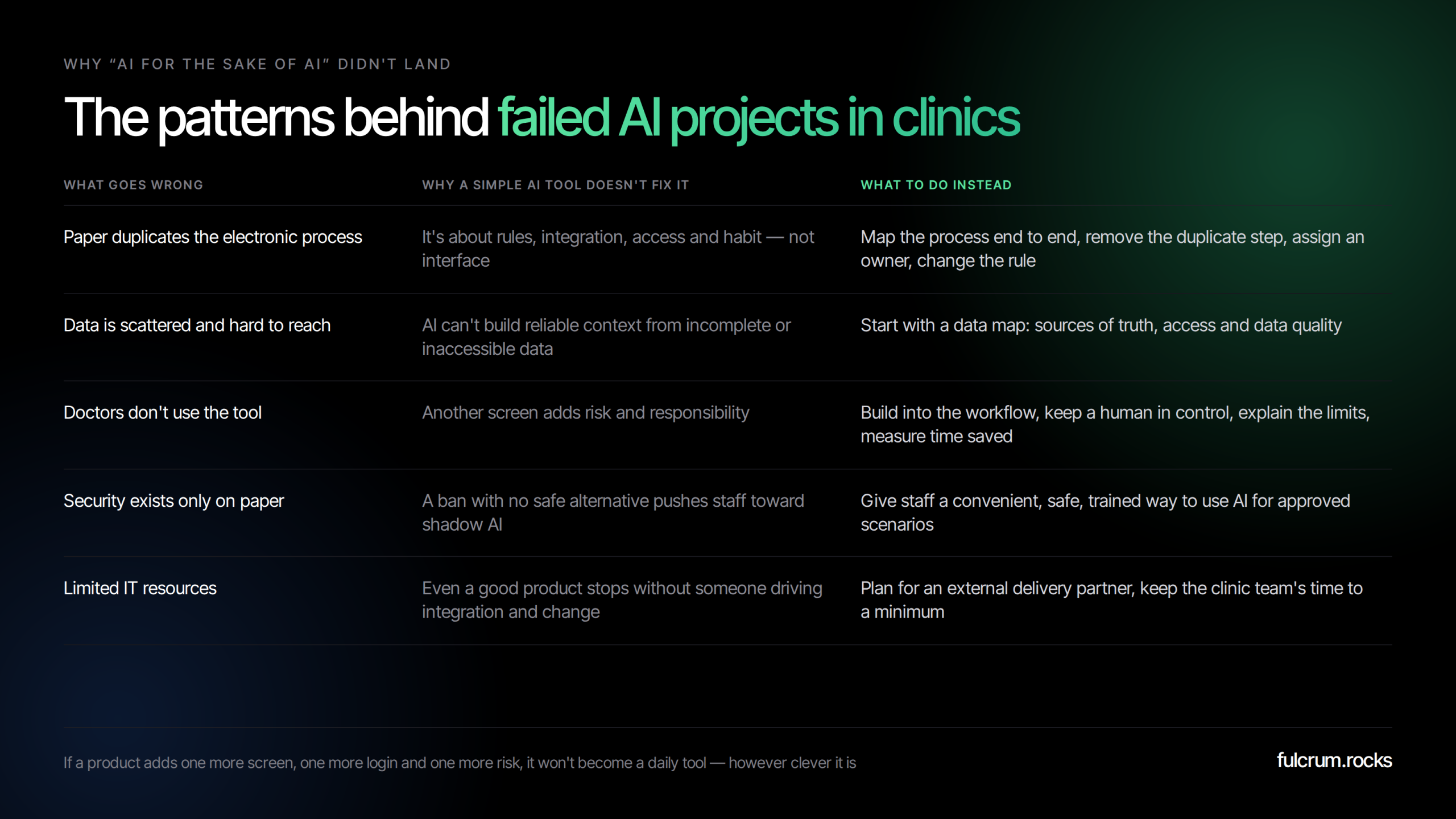
Why “AI for the sake of AI” didn’t land
The most convincing examples at the forum were tied to a metric: doctor time saved, quality control, processing speed, patient throughput, costs. Talks about AI as a concept fell flat.
The reason is practical. If a product adds one more screen, one more login and one more risk, it won’t become a daily tool, however clever it is. Doctors shouldn’t have to work in parallel systems.
That’s why integration with the medical information system (MIS, the clinic’s EHR) is a critical barrier to adoption. AI has to return its results into the screen the doctor already uses. Some clinics are already integrating their radiology information systems (RIS) with their MIS, and that’s the pattern to follow.
A few more patterns behind failed AI projects:
Security, liability and patient data: the condition for trust
In healthcare, security isn’t a box to tick at the end of a sale. It’s part of the value clinics are paying for, especially when AI touches medical data or integrates with core systems.
The questions I heard most were simple and serious: who is responsible when AI makes a mistake, where is sensitive data stored, and how do we stay within the rules? Every AI pilot in a clinic needs a clear answer to all three:
- Human-in-the-loop. AI recommends or checks. It never becomes an unexplained source of a clinical decision.
- Logging and access control, so you always know who saw what and when.
- A narrow scope for what the AI is allowed to do.
- A legally clear setup that the clinic’s leadership can explain and defend.
If you build software for clinics, our HIPAA compliance guide covers how to design for this from day one.
Small clinics need affordable cybersecurity
For small and mid-sized clinics, a full compliance programme feels expensive and out of reach. Yet their biggest risks are basic: phishing, unpatched software and weak access controls. There’s a real gap for a minimum viable security baseline: multi-factor authentication, access management, updates, backups, staff training and an incident playbook, at a predictable price.
Moving data to the cloud has a cost, not just a technical challenge
Radiology data is the clearest example. Storing large image archives in the cloud is expensive, and many clinics still depend on local servers. Any honest plan for cloud migration has to count data volumes, hot and cold storage, backups, availability and the cost of the move itself.
How clinics decide on AI
An AI decision in a clinic has several owners, and each one judges it by a different question. A pitch that answers only one of them stalls.
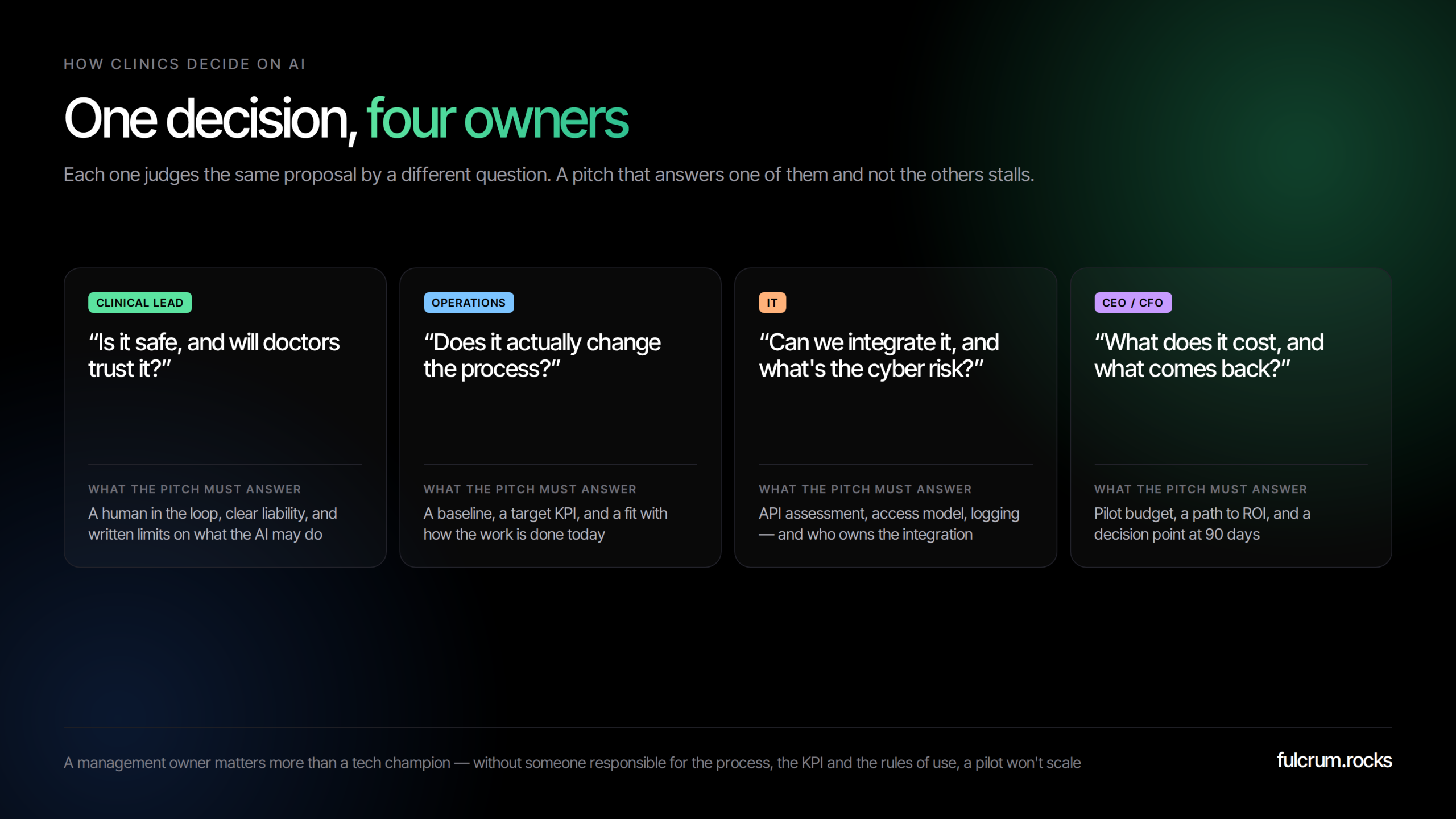
A few more things I noticed about how decisions really get made:
- A management owner matters more than a tech champion. Without someone responsible for the process, KPI and rules of use, a pilot won’t scale, even with a strong IT team.
- The first choice is about lowering risk, not maximising features. Clinics agree more easily to a narrow process, read-only integration, de-identified data and a human in the loop.
- Doctor trust is its own success metric. The tool has to support the doctor’s expertise, not make them the one to blame for the system’s recommendation.
- Partnerships help but don’t remove complexity. The MIS provider, a security partner and the clinic all have different approval cycles, so someone has to own integration and support.
How to start: a 90-day AI pilot in a clinic
A big transformation project without an owner and quick proof rarely gets off the ground. The most realistic way to implement AI in a clinic is a narrow 90-day pilot of one process, with a baseline and a measurable result. Here’s how I’d run it:
- Start with the process, not the technology. Pick the one process with the biggest manual losses, and name the person who owns it.
- Measure the baseline. How much routine work is there, what does an hour of a specialist’s time cost, how many specialists are involved, and what KPI will you move?
- Check the data before you build. Where does the data live, how good is it, who can access it, where is it stored and how will it integrate with the MIS?
- Lower the risk first. Start with read-only access or de-identified data, a narrow scenario and a human in the loop, not full automation.
- Build it into the existing workflow. Results go back into the system doctors already use. No new parallel interface.
- Agree the decision in advance. After 90 days, you scale it, change the approach or stop. Budget follows proof, not promises.
The result to sell internally is never “we now use AI”. It’s time saved, quality improved, faster processing, higher throughput, lower process costs, or happier staff and patients.
Beyond healthcare: the next wave of digital transformation
The forum made something else clear. Healthcare is a good example of a much bigger group: offline businesses that aren’t ready to scale AI yet, because they’re still building basic digital maturity.
They share the same pain: manual processes, paper, disconnected systems, poor access to data, many handovers between people, limited IT resources, and nobody leading digital change. AI can’t simply be layered on top. First the processes have to be digital, the data accessible, and responsibility and security clear.
The approach that works is the same in every industry: find the process with the biggest manual losses, move it into a controlled digital workflow, connect the existing systems and data, add AI only where it saves time or improves quality, and take the team through the change.
Healthcare is a tough test of that approach: the cost of mistakes is high, the data is complex, regulation is strict and tolerance for half-finished tools is low. What works there will carry over to logistics, manufacturing, service networks, real estate, education and professional services.
Where to go from here
The clinics that will get real value from AI in 2026 aren’t the ones buying the most tools. They’re the ones that pick one process, fix the data under it and prove the result in 90 days.
At Fulcrum, we build healthtech products with security and compliance designed into the architecture from day one, and we start with the process, not the technology. If you’re choosing your first AI pilot and want a second opinion on where to begin, my inbox is open.
Talk to us about your first AI pilot →
And if you were at Digital Medicine Forum too, I’d love to hear what stood out for you.
AI in Clinics FAQ
-
How do you implement AI in a clinic?Start with one process that has clear manual losses and a named owner. Measure the baseline, check the data and integrations, then run a 90-day pilot with a human in the loop and a decision agreed in advance: scale, change or stop.
-
What are the best AI use cases in healthcare right now?The most mature ones support staff rather than replace them: quality control of medical reports and prescriptions, AI assistants for doctors, data anonymisation for analytics, call centres, scheduling and patient routing.
-
How much time can AI save doctors?One benchmark shared at Digital Medicine Forum 2026 was up to 2 hours a day on background tasks such as documentation. The real number depends on the clinic, so measure it in your own baseline.
-
Why don't doctors use the AI tools clinics buy?Usually because the tool sits outside their main system. If it adds another screen, login or risk, it won't become part of daily work. Integration with the MIS or EHR is what drives adoption.
-
Is AI safe to use with patient data?It can be, if security is designed in from the start: de-identified or read-only data where possible, role-based access, logging, a narrow scope and a human making the clinical decision.
-
Can small clinics afford AI and cybersecurity?Yes, if they start small. A basic security baseline (MFA, access management, updates, backups, training) covers the most likely risks. A narrow pilot keeps the first AI investment manageable.