I’ve spent the last five years on the founder side of this decision. At Fulcrum we’ve built a digital fertility clinic (Zuri), a medical device platform for clinicians (QuickTouch), a physician marketplace that went through enterprise procurement at GoodRx (flipMD) and an AI fertility wellness app (Vie). In almost every first call, the founder asks the same thing: “Who else should I talk to?” This list is my honest answer.
One disclosure before we start: Fulcrum is on this list. I’ve kept our entry to the same format as everyone else’s, including where we’re not the right fit. Every company profile below is based on what each company publishes about itself. Check anything that matters to your decision on a call.
How I picked these ten
Most “top 10” lists rank vendors on reviews and logos. Those matter, but they won’t tell you whether a team will protect your patients’ data at 2 a.m. on a release night. So I looked for five things I’ve learned to check the hard way:
- US delivery or a US entity you can sign a BAA with. If the vendor’s engineers will touch production PHI, they’re a business associate, and the agreement has to be enforceable where you operate.
- Public proof of healthcare work. I wanted named clients, case studies or product outcomes, not just a “Healthcare” tile on the services page.
- A stated approach to HIPAA in the build itself. I looked for access control, audit logging, encryption and environments described as part of delivery, not as an add-on at the end.
- A clear engagement model. Can a founder tell what an MVP costs and how long it takes before the first call?
- A fit for a specific kind of founder. A 30-year enterprise vendor and a startup studio can both be excellent. They’re rarely excellent for the same buyer.
I didn’t audit anyone’s code, and no company paid to be included. One note on wording: there’s no official “HIPAA certification” for software or vendors in the US. When a company says “HIPAA-compliant,” it means its processes are designed to support your compliance. You, as the covered entity or business associate, still own the outcome.
If you’re open to an offshore team, we’ve also compared healthcare software development companies in Ukraine.
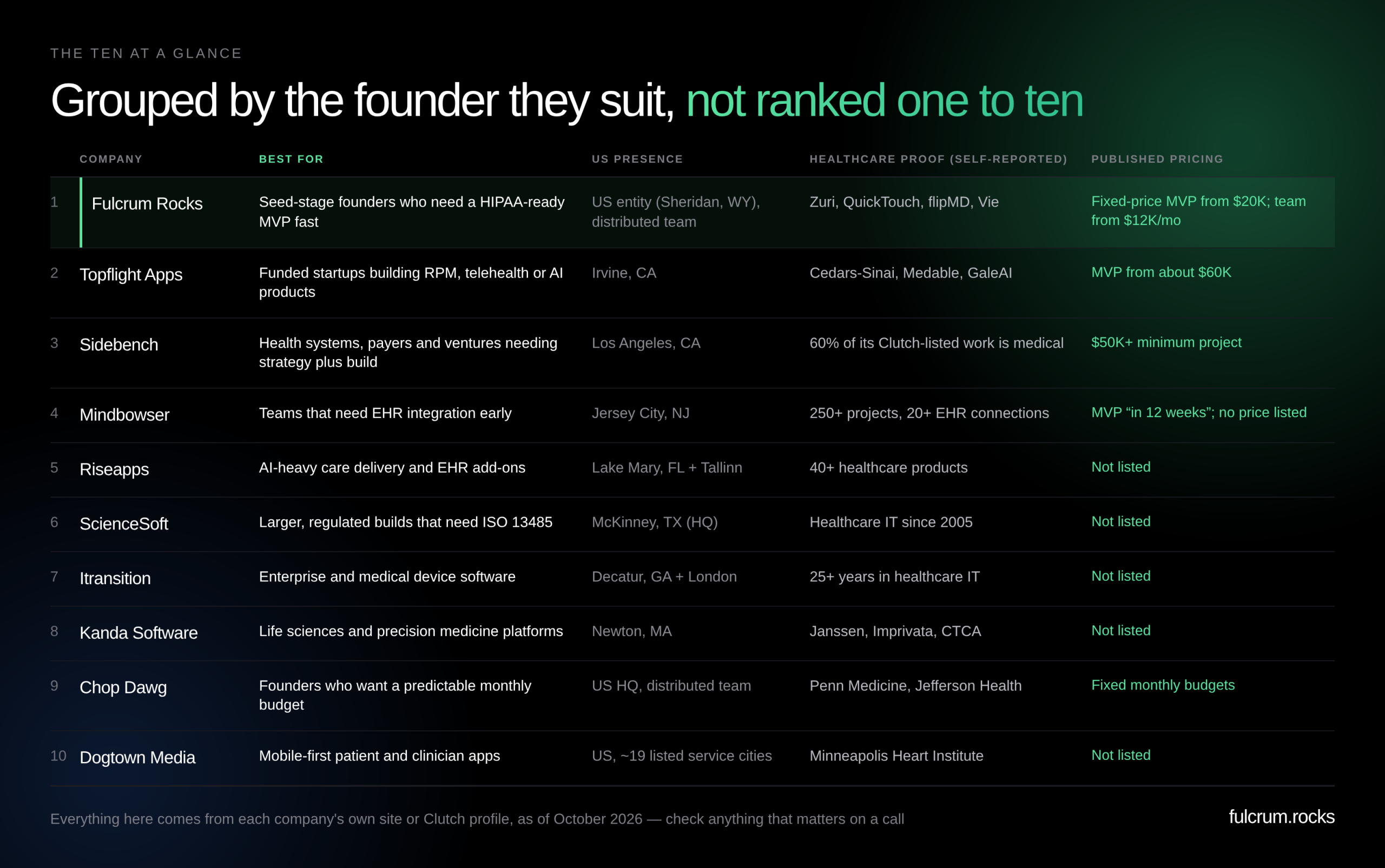
Everything in this table comes from each company’s own site or Clutch profile, as of October 2026.
The ten HIPAA-compliant App Development Companies
1. Fulcrum Rocks
This is us, so I’ll keep it factual. We build HIPAA-compliant web and mobile apps in 4 to 10 weeks, with fixed-price MVPs from $20K and a dedicated team from $12K a month. We hold a 4.9 on Clutch. In healthtech we’ve shipped Zuri, a digital fertility clinic, in three months. We also built QuickTouch, a medical device platform for clinicians, as an MVP in 10 weeks. And flipMD, a physician marketplace we built with its founders, passed enterprise procurement at GoodRx, which later acquired it.
2. Topflight Apps
Best for: funded startups building remote patient monitoring, telehealth or AI products.
Topflight is based in Irvine, California, and it publishes its pricing, which I respect: MVPs from about $60K in 1.5 to 2 months, and more complex builds with EHR, IoT or ML from $200K. Its site shows Cedars-Sinai, Stanford Medicine and Medable among partners. Its featured case, GaleAI, is an AI medical coding platform. Topflight also says it aligns builds with HITECH, IEC 62304 and SOC 2 Type 2 where needed.
Worth asking: which of those standards apply to your product, and who owns the documentation once the build ends.
3. Sidebench
Best for: health systems, health plans and digital health ventures that need product strategy as much as engineering.
Sidebench was founded in 2012 in Los Angeles. On Clutch it holds a 4.9 from 48 reviews, and medical work makes up 60% of its listed projects. Its reviewers include Rectangle Health, Diathrive and Kenshō Health. It also mentions one health plan client with more than 30 engagements over seven years, which tells you something about retention.
Worth knowing: the $50K project minimum puts it out of reach for most pre-seed founders.
4. Mindbowser
Best for: products that need to talk to Epic, Cerner or athenahealth early.
Mindbowser lists a US office in Jersey City, New Jersey. It claims more than 250 projects and 200+ HIPAA- and FHIR-trained staff. Its integration engine, ConnectHealth, connects to more than 20 EHRs, and it offers a digital health MVP “in 12 weeks” built on pre-built components. It also says its security controls are SOC 2 Type II audited.
Worth asking: what the accelerators save on a scope like yours. Its site gives several different time-saving figures.
5. Riseapps
Best for: AI-driven care delivery, and patient apps built on top of an existing EHR.
Riseapps lists offices in Lake Mary, Florida and Tallinn, Estonia, and has built healthcare software since 2016. It claims 40+ healthcare products, with named clients like BlackDoctor, Amen Clinics and CareHalo. The case I found most useful was a branded patient app built in 8 weeks on a practice’s existing athenahealth EHR, without migrating data. It’s also ISO 27001 certified and says it designs for HIPAA “from the first sprint.”
Worth asking: where your PHI will be processed, given the split US and EU delivery.
6. ScienceSoft
Best for: larger, regulated builds where an ISO 13485-certified partner matters.
ScienceSoft is headquartered in McKinney, Texas, and has worked in healthcare IT since 2005. It describes itself as an ISO 13485-certified partner and offers HIPAA compliance consulting alongside development. That combination is rare and useful if your product sits close to medical-device territory.
Worth knowing: there’s no published pricing, and the process is built for larger scopes than a typical seed-stage MVP.
7. Itransition
Best for: enterprise healthcare software and medical device software.
Itransition lists a US office in Decatur, Georgia, and claims 25+ years in healthcare IT. It cites experience with FDA class II and III software and IEC 62304 classes A to C, plus HIPAA- and HITECH-compliant delivery. It holds a 4.9 on Clutch from 42 reviews. Its case studies include a platform used by 30+ healthcare institutions and a solution running in 400 blood centers.
Worth knowing: this is enterprise scale. Founders should ask who exactly will work on a smaller project.
8. Kanda Software
Best for: life sciences, diagnostics and precision medicine platforms.
Kanda is based in Newton, Massachusetts, and has more than three decades in software. It names Janssen, Imprivata and CTCA among its clients. One testimonial describes eight years of work with Trapelo on precision medicine for cancer therapy selection. It holds ISO/IEC 27001:2022 and says it builds “HIPAA compliant, interoperable and secure” solutions.
Worth knowing: its site doesn’t mention FDA or SaMD work, so check that directly if it matters to you.
9. Chop Dawg
Best for: first-time founders who want a predictable monthly budget.
Chop Dawg was founded in 2009. It’s US-headquartered with a distributed team and works on fixed monthly budgets. It names Penn Medicine and Jefferson Health among its healthcare work. It also wrote the list that inspired this one, so we’re even on disclosure.
Worth asking: which team members will touch PHI, and in which countries they work.
10. Dogtown Media
Best for: mobile-first patient and clinician apps.
Dogtown Media focuses on iPhone and Android. Its HIPAA page lists encryption, role-based access, audit logging, MFA and continuous vulnerability assessment as part of the build. Its named healthcare example is an app for the Minneapolis Heart Institute that digitized cardiovascular emergency protocols that used to live on paper.
Worth asking: for more healthcare references, since its HIPAA page names only one.
What a HIPAA-ready vendor should hand you (lessons from our own builds)
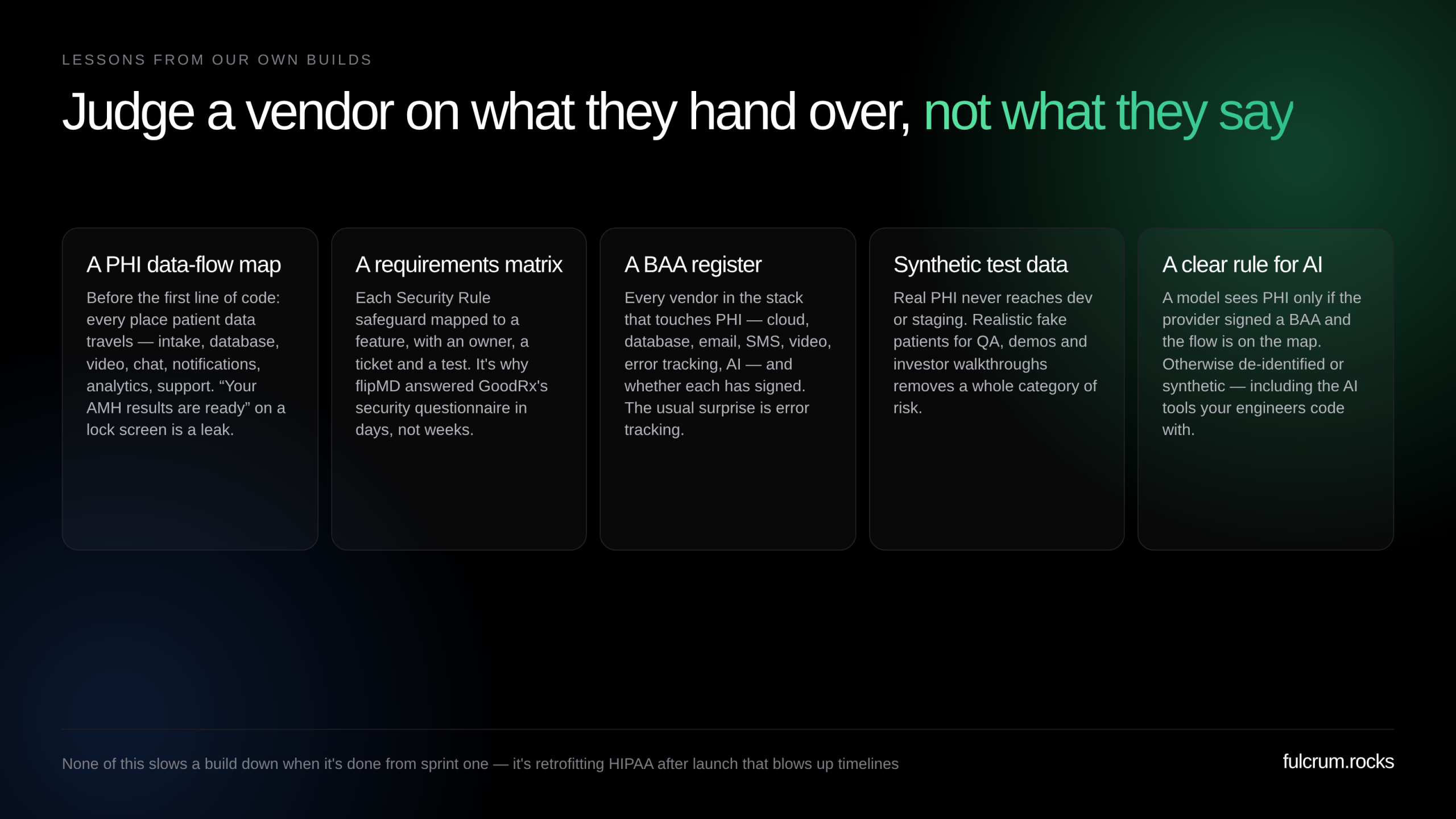
After several healthcare products, I’ve stopped judging vendors on what they say about HIPAA. I judge them on what they hand over. If a team can’t produce these five things in the first weeks, compliance is going to be your problem later.
1. A PHI data-flow map before the first line of code. Our most important design session on Zuri happened at a whiteboard, mapping every place a patient’s fertility data would travel: intake form, database, video visit, chat, notifications, analytics and support tools. Push notifications and analytics are where founders leak PHI by accident. “Your lab results are ready” is fine. “Your AMH results are ready” on a lock screen is not.
2. A requirements matrix that maps each HIPAA safeguard to a feature. Every Security Rule requirement should have an owner, a ticket and a test. Think unique user IDs, automatic logoff, audit controls, encryption and integrity checks. When flipMD went through GoodRx’s procurement review, that matrix let the founders answer the security questionnaire in days instead of weeks. Enterprise buyers won’t take “we’re HIPAA-compliant” on its own. They ask you to show them.
3. A BAA register. List every vendor in the stack that touches PHI: cloud, database, email, SMS, video, error tracking, AI. Then record whether each one has a signed business associate agreement. The usual surprise is the error-tracking tool, which happily captures a request body full of patient data.
4. Synthetic test data from day one. Real PHI should never reach dev or staging. We generate realistic fake patients so QA, demos and investor walkthroughs never risk a breach.
5. A clear rule for AI. Founders now expect AI features, and on Vie the chatbot was the product. An AI model only sees PHI if the provider has signed a BAA and the data flow is on the map. Otherwise, it works with de-identified or synthetic data. The same goes for the AI tools our engineers use to write code. They never get production data.
None of this slows a build down when it’s done from sprint one. QuickTouch went from kickoff to MVP in 10 weeks with role-based access for reps and care teams built in. It’s retrofitting HIPAA after launch that blows up timelines and budgets.
One more reason to start now: HHS proposed a major update to the Security Rule in January 2025. It would make encryption, MFA, network segmentation, annual penetration tests and tested incident response plans explicit requirements. Final action is now listed for July 2027. Building to that bar today costs far less than catching up later.
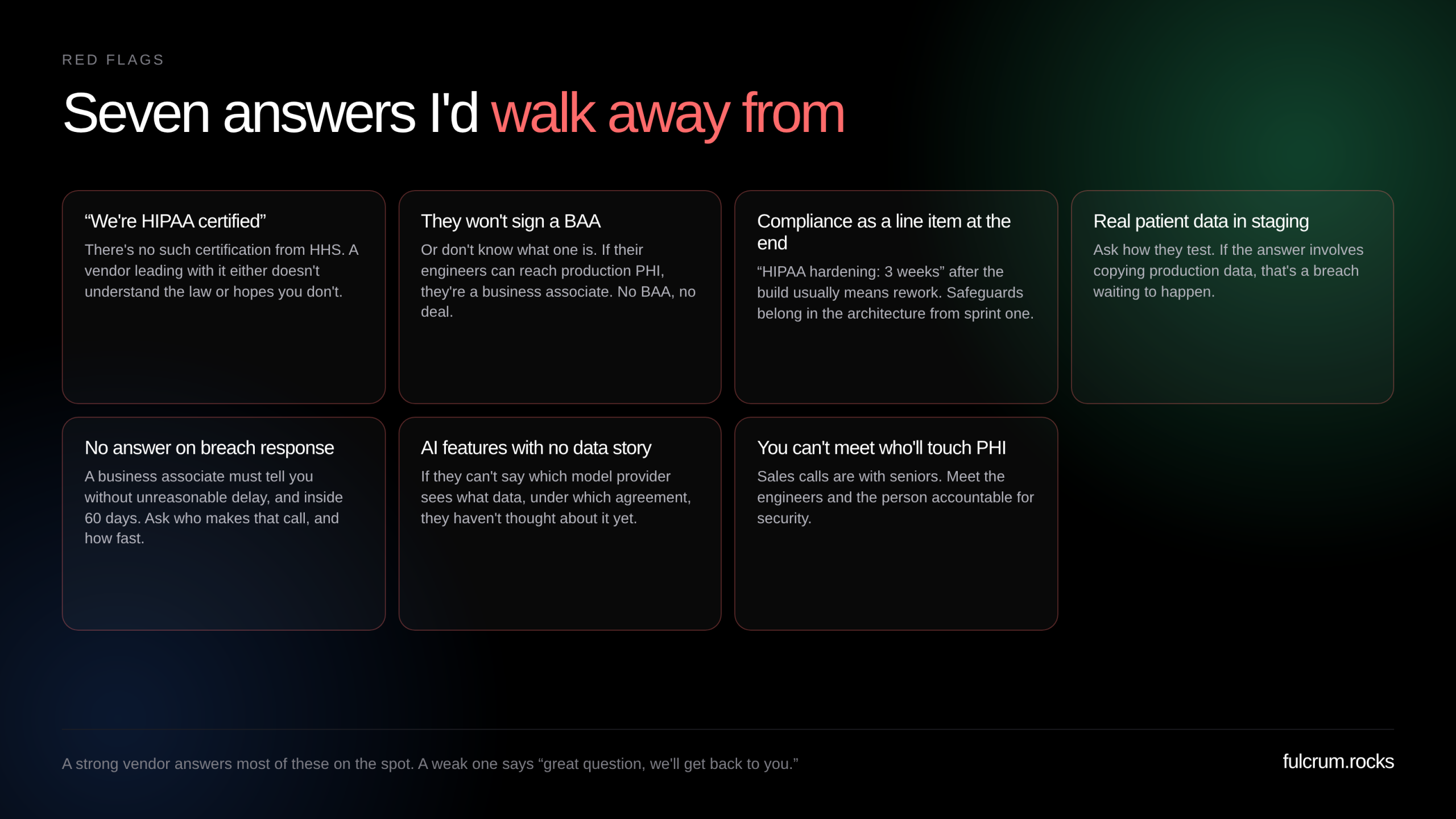
Red flags I’d walk away from
- “We’re HIPAA certified.” HHS offers no such certification. A vendor that leads with it either doesn’t understand the law or hopes you don’t.
- They won’t sign a BAA, or don’t know what one is. If their engineers can reach production PHI, they’re a business associate. No BAA, no deal.
- Compliance is a line item at the end of the estimate. “HIPAA hardening: 3 weeks” after the build usually means rework. Safeguards belong in the architecture from the first sprint.
- Real patient data in staging. Ask how they test. If the answer involves copying production data, that’s a breach waiting to happen.
- No answer on breach response. A business associate must tell you about a breach without unreasonable delay and no later than 60 days after discovering it. Ask who on their side makes that call, and how fast.
- AI features with no data story. If they can’t explain which model provider sees what data, under which agreement, they haven’t thought about it yet.
- You can’t meet the people who’ll touch PHI. Sales calls tend to be with senior people. Make sure you also meet the engineers and the person accountable for security.
Eight questions to ask on the first call
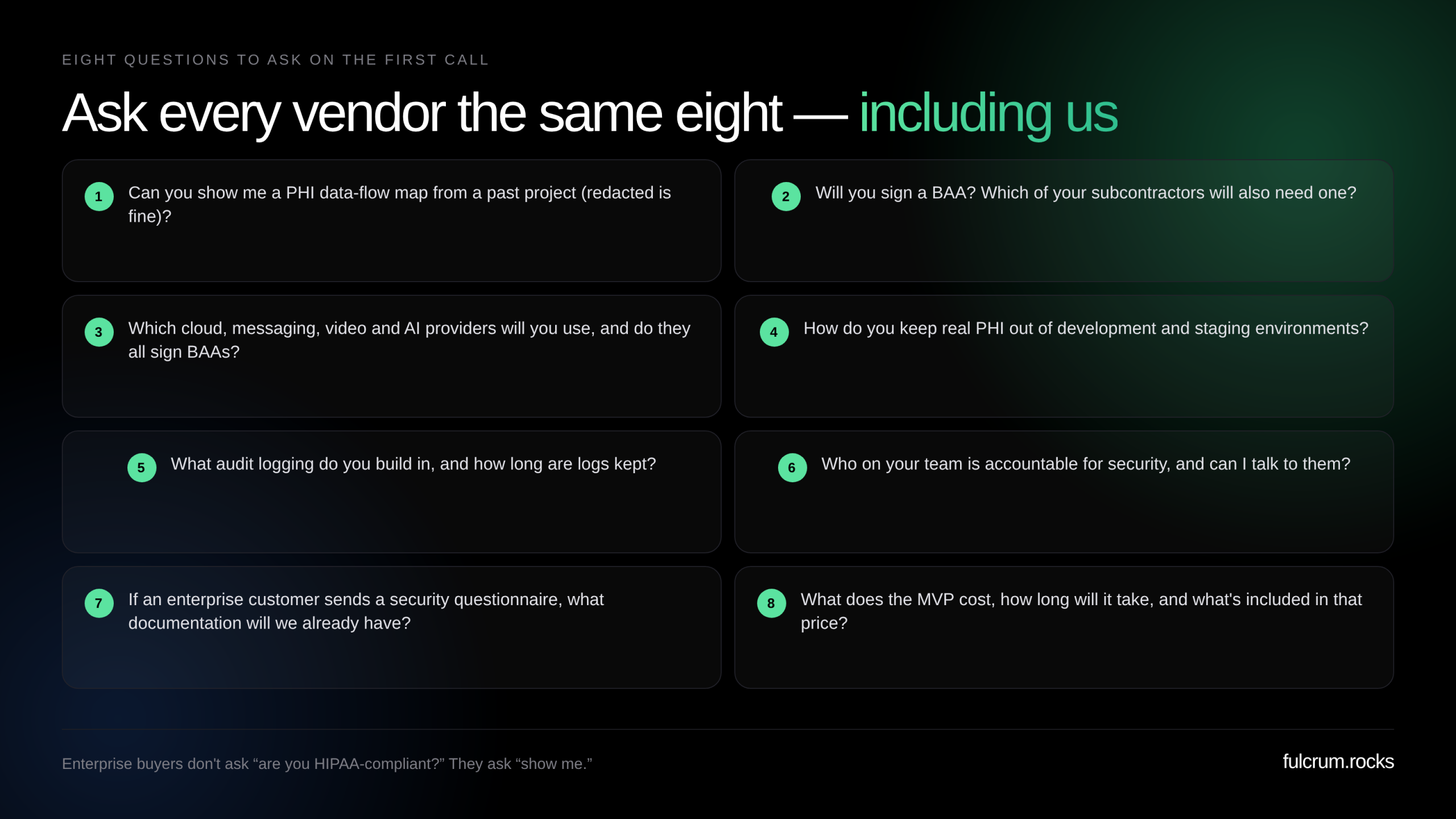
I’d ask every vendor on this list, including us, the same eight questions:
- Can you show me a PHI data-flow map from a past project (redacted is fine)?
- Will you sign a BAA? Which of your subcontractors will also need one?
- Which cloud, messaging, video and AI providers will you use, and do they all sign BAAs?
- How do you keep real PHI out of development and staging environments?
- What audit logging do you build in, and how long are logs kept?
- Who on your team is accountable for security, and can I talk to them?
- If an enterprise customer sends us a security questionnaire, what documentation will we already have?
- What does the MVP cost, how long will it take, and what’s included in that price?
A strong vendor answers most of these on the spot. A weak one says, “Great question, we’ll get back to you.”
HIPAA Compliance FAQ
-
How much does a HIPAA-compliant app cost in 2026?Published prices vary widely. On the low end, fixed-price MVPs start around $20K (Fulcrum). Topflight lists MVPs from about $60K and complex builds with EHR, IoT or AI from $200K. What moves the number most is integrations, especially with EHRs, and whether the product is regulated as a medical device. HIPAA safeguards built in from the start add little. Retrofitting them later adds a lot.
-
How long does it take to build one?A focused MVP can launch in 4 to 10 weeks if the scope is tight and the safeguards are designed in from sprint one. QuickTouch took 10 weeks to MVP, and Zuri, a full digital clinic, took three months. EHR integrations, FDA requirements or multiple user roles add time.
-
Does every health app need to be HIPAA-compliant?No. HIPAA applies when you’re a covered entity (a provider, health plan or clearinghouse) or a business associate handling PHI on their behalf. A consumer wellness app that people use on their own may fall outside HIPAA. Even then, it can still fall under FTC rules and state privacy laws. If you plan to sell to providers or payers later, building to HIPAA from the start saves a rebuild.
-
What happens if there’s a breach?Affected individuals must be notified without unreasonable delay and no later than 60 days after discovery. Breaches that affect 500 or more people must also be reported to HHS within that window and, in many cases, to the media. Smaller breaches are reported to HHS once a year.
-
Is HIPAA changing?Yes, probably. HHS proposed a stricter Security Rule in January 2025, with explicit requirements for encryption, MFA, network segmentation and annual penetration testing. As of July 2026, final action is listed for July 2027.